Wednesday, March 16, 2011

When one door closes...

I write with regret to announce that Maine Enterprise Schools is, at least for now, going on hiatus. There are two reasons. We’ve not been able to secure an agreement with a public school district for a 2011 launch, despite getting very close several times. And our non-profit partner, LearningWorks, has decided that the small autonomous public schools that we seek to create are not consistent with their long-term strategy.

In both cases, the promise of charter school legislation may, somewhat paradoxically, be working against the theory of action we’ve been advocating: that public schools themselves are better off leading innovation than having it forced upon them.

I’ll post a longer entry at innovationmaine.blogspot.com; suffice it to say that we tried just about every available avenue to realize our mission. After more than two years of exciting and challenging work, the stars (and finances) are simply not aligned for the kind of integrated model we advocate.

This does not mean that our efforts have been for naught. Our work has influenced the debate around school reform at the state level and in individual schools and districts in Maine. Some of the non-profit partners we’ve worked with are adopting/adapting aspects of the asset-based, sustainable economic development approaches we’ve championed. Most importantly, we’ve been able to bring together LOTS of people from across many sectors to imagine something quite different for Maine’s young people.

MES assigned itself a daunting challenge: to create systemic change in education, commerce and the environment using existing community assets. These assets – the people, places, buildings, and systems - are inevitably tied to tradition, and in turn to organizations or institutions. Even though the fundamental assumption that existing resources can produce better results if allocated differently is one that most folks can see the wisdom of, the actual reallocation of those assets requires the willing participation of the gatekeepers of those organizations and institutions. Ultimately, we were unable to convince those folks that the benefits of doing so now outweigh the cost of not doing it.

Now marks a point of change for MES. For the short term, we plan to refocus our energies on the enterprise incubator and “blended value” investment aspect of the original MES vision. To this end, we hope to gather folks who genuinely support our approach and want to help us figure out how best to capitalize on the work we’ve done. In early April (time and place to be announced) we’ll host a “where we’ve been, where we’re at, and where we’re going” meeting.

If you want to be at that meeting, please let us know. In keeping with the MES collaborative approach, the more voices the better. Send an email jdanieri@mainefarmschool.org, - a simple, "I'm in" will work. And of course we welcome lengthier feedback anytime.

William Faulkner wrote, “All of us failed to match our dreams of perfection. So I rate us on the basis of our splendid failure to do the impossible.” My most genuine thanks and appreciation to everyone in the MES community for joining me in what has been a splendid, if for now incomplete, quest.


John D'Anieri

Friday, December 31, 2010

Novel School Model Sowed

Please check out Seth Koenig's article in today's Brunswick Times-Record. Having expended so many words myself trying to get MES off the ground, it is SO nice to see a thoughtful writer bring these ideas into the public sphere the old-fashioned way.

And if you can help us make the ideas a reality with a financial donation before the end of the year, please do. Use our Network for Good online donation link, or if you’d prefer to donate by check, make the check out to LearningWorks (our fiscal agent) and write Maine Enterprise Schools in the subject line.

Our address is:
Maine Enterprise Schools
PO Box 854 Brunswick, ME 04011

We look forward to working together in the New Year - please visit our InnovationMaine blog to learn more the policy work we're doing to make it all possible.

Wednesday, December 22, 2010

Rural Charter Schools work!

This story from Oregon gives lots of hope for those in small communities in Maine that may, or in some cases already have, seen their schools close.

"With dwindling enrollment and a state funding crisis, Hughes told community members the 130-student K-12 school -- split between two buildings -- would likely have to close its doors within two to three years. Now, nearly three years later, Elkton has new computers, new curriculum and materials and nearly 80 new students.

What changed? Elkton became a charter school."

Monday, December 20, 2010

Charter schools suddenly 'relevant'

The charter school meeting hosted by the Maine Association of Charter Schools did indeed make clear that charters are relevant and that they are likely to happen. The 50 or so folks gathered on Thursday represented a very broad spectrum - legislators, school superintendents and potential charter school operators.

What was most exciting about the meeting is the degree to which folks who might not be seen as allies on most issues were able to find genuine common ground on the need to innovate. I spoke with a newly elected Republican legislator and a long-time liberal activist who were agreeing word for word with each other on how a well-structured charter law could help meet the needs of the young people in their very similar towns.

What continues to be discouraging is the lack of sophistication of some of the public debate surrounding charters, which came through quite loudly in the Portland Press Herald's article. My problem here is not with Mr. Stone's reporting - he has to report what is being said, and did a much better job of highlighting some of the many variables, rather than just perpetuating the myths.

Saturday, November 13, 2010

MES in the news

Check out Saturday's article in the Portland Press Herald. Mr. Murphy did a superb job in capturing the potential of schools that "would be a blend of a traditional school and small-business incubator."

Group wants schools that mix business with lessons

We have a few quibbles about a few lines that could create some misunderstanding. Not the fault of Mr. Murphy, whose cheese-making example (crafted with some help from MES board member, Rosemont Market special project juggler, and very funny PPH wine writer Joe Appel) explains simply and elegantly the potential of learning linked to doing linked to the real work and markets of Mainers. The challenge Mr. Murphy, and MES faces, is describing a very different approach in the terms of the current system, which, quite frankly, makes some assumptions about learning and schools that we do not.

Friday, November 12, 2010

Time to Address Child Poverty and High Dropout Rates in Maine

From Brunswick Times-Record:

Time to Address Child Poverty and High Dropout Rates in Maine

I have often wondered why, as a society, we find it so difficult to address crucial problems like child poverty, child neglect, high dropout rates and student underachievement. Instead, we grind and rattle our way down the road until the wheels fall off the cart. We are now at the breakdown point with regard to our at-risk kids, and the costs of doing business as usual are bankrupting us. Consider the following:

• On average 21 students in Maine drop out of school each day, with the class of 2009 estimated to have lost 3,800 kids.

• The societal cost for each high-school dropout is approximately $292,000, due to reduced wages and taxes, welfare and high health-care costs, and--as is all to often the case--the costs of incarceration.

• Dropouts are 3 1/2 times more likely to wind up in jail than non-dropouts.

• It costs approximately $47,000 per year to incarcerate someone—more than the cost of sending that person to Harvard ($43,000).

Saturday, October 23, 2010

Rationale for Maine Enterprise Schools explained!

If you can find 11 minutes in the next day or two, I urge you to find time to listen to/watch Ken Robinson's animated dissection of the degree to which our current system of education is profoundly unsuited for our times and our children.

http://www.youtube.com/user/theRSAorg


Many of you have heard me or others say many of the same things - that batch processing kids deadens their motivation, that natural curiosity gets labeled ADHD, and that we make a false and damaging distinction between academic learning and hands-on learning. My favorite part, if were not so sad, would be when he shares the study that demonstrates the degree to which, over time, our schools greatly reduce the natural capacity for divergent thinking that almost every child is a "genius" at.

I'll be showing this video everywhere I can from here on out - Sir Kenneth elucidates the intellectual underpinnings of what we're trying to do with Maine Enterprise Schools better than I ever could - and it makes me that much more eager to be part of the creation of a new system, were the beauty of an education driven by deep, lived experience with the arts, ecosystems, and the real work of humans (and their machines) is available to every single child, regardless of place or parentage.

Tuesday, October 12, 2010

Impact Investing

NY Times article, fowarded by Russel Libby of MOFGA, points out that while "the notion that for-profit companies with a social mission at their core could constitute an “asset class” is fairly new," the sector is poised for "explosive growth."

Plenty of challenges, not the least of which is "the mindset of many investors." But the article illustrates that the kinds of social investing/venture philanthropy strategies that MES is creating are out there, are growing, and will have an impact.

Sunday, October 3, 2010

Name Change, Partnership, Temporary Website

Maine Enterprise Schools has dropped the Farm from our name and we're entering into partnership with Learning Works to jointly develop the MES concept. We're working on a new website, but until we get there, this blog will serve (along with our facebook site) to update folks. The links above lead to various aspects of our work to date. To the right is our Innovation Maine education blog (to which we're posting regularly now) and the MaineFarmSchool.org site, along with an assortment of links that inform our work.

Let us know what you think...comment or email John at jdanieri@mainefarmschool.org

Wednesday, February 17, 2010

Six Assertions

Longtime Portland Educator Gary Vines sent me the website of Education|Evolving; one of the things I love about it is that the home page starts with six assertions. "Click on one of these and you will be taken to second listing of more specific assertions in that area. Click on any one of these and you will be taken to a listing of reports, newspaper clippings, audio recordings, links, etc. that we have created or made available because they explain or support that assertion."

One such sub-assertion: "a radically different model of school organization, in which the authority for arranging both the learning program and the administration of a school is placed with a formally-organized group of teachers . . . and in which the teachers accept collegially the responsibility for the school's success."

The model also asserts that the organization and governance model of the school matters a great deal - if we create communications and decision-making structures that work on a human scale, we can be genuinely accountable to our students, colleagues parents, and community. Our approach, while similar in spirit, it not entirely teacher-led; while all decisions about teaching and learning rest with the teachers (our Professional Learning Community model of curriculum implemenation, teacher improvement and advancement) we envision two other key governance elements; facilitative leadership from principals and participative citizenship from students.

Our principals are "facilitative leaders" charged with maintaining that Professional Learning Community and with connecting the work of each site to the larger network of schools (in addition to being the public face of our sites, managing reports and data and compliance, etc.). One of the key characteristics of the best replication models is that effective sharing of practice - both within schools and among similar schools - enable the teachers working in them not only to get consistently better individually, but to get better at the unique aspects of the model. In a sense, our principals are "cheif accountability officers." Technocratic as that sounds, it combines the role of head coach, ombussman, and curriculum director to ensure fidelity to the "best practices" that we are building our model on. For more on this, see Debbie Maier's article in the Summer 2005 issue of Rethinking Schools, or the websites of the School Reform Initiative or the National School Reform Faculty.

The small school structure is crucial as well to ensuring that every student is a participating citizen in the governance of the school. In addition to monthly all school, parliamentary style meetings, students are expected to develop the skills to largely self-manage school culture. Structures like civil rights teams, peer mediation, fairness committees and restorative justice systems enable student input to beyond planning dances and complaining - and at a small school, both enable and require each student to play a regular role. For more, see Everyday Democracy.

Small is beautiful and radical

In this article, "Small is beautiful and radical" Maine local agriculture advocate Eliot Coleman uses French comic heroes Asterix and Obelix to explain why the transition to small farms is radically beautiful! He makes the point that small organic farms are ultimately about nutirtion, and draws important distinctions between those farms and market-motivated agribusiness or large-farm interests go organic. Not long ago, I heard John Piotti of Maine Farmland Trust say that organic or conventional is not as crucial as "sustainable" and that finding the right balance will enable Maine to emerge as as major agricultural state in the new food economy. Eliot argues that both organic and small matter...thoughts?

Race to the Top?

The article "Is Academic Overachievement Hurting our Kids" raises questions about the impact of both the competitive achievement and high stakes testing cultures that have come to characterize how we measure, place value on, and offer opportunity to our young people. The title answers the question: over achievement by definition implies too much of something. If the question were posed as, "Is underachievement hurting our kids?" there would be little to argue about. The better questions have to do with what we mean by achievement, what we mean by standards, how we measure such things, and what effect those measurements have on kids and on the larger society.

Grades, especially numeric averages, are primarily useful for sorting; they sort, first, the kids who behave in a way to that produces high numerical grades from those who do not. Exacerbated by college admissions systems that place ever-greater emphasis on micro-distinctions between numerical ratings, many kids become "high-achievers." Without being too flip, Wall St., Washington DC, and our health care system might be offered as evidence that the measures for sorting and providing employment to high achievers has little overall benefit to society (though it clearly has economic benefit to the folks who come out on top.)

Standardized tests are not nearly as damaging to kids as numerical grades - in fact, properly used as data sources that inform strategies such as "assessment for learning," they can be invaluable. The problem is in the substitution of such data for all other measures. In implementation, they become rigid, limiting, decontextualized lists which systems and teachers then feel forced to teach to. NCLB's promise was that, after years of well-intentioned "reform," (what GW Bush, or more likely his speechwriters, referred to as, "the soft tyranny of low expectations") there was finally some teeth in the proposition that schools needed to try to teach ALL kids well. Unfortunately, achieving such limited-scope data gains became the means by which schools, principals, and now, if Arne Duncan has his way, individual teachers are assessed.

This approach squeezes out all of the other aptitudes and accomplishments that not only are not measured by such tests, but that thrive in opposition to such narrow definitions of human learning and capacity. Traits like curiosity and creativity that underlie all genuine great achievement, or skills like problem-solving in context that enable students to not just pass tests, but to understand the value of and applications for the concepts they're being tested on, become a luxury.

MFES' position is this:
High standards are necessary for ALL students, and measurement of those standards is crucial to effective teaching and learning. But numerical grades and standardized test are at best, a small part of that. How do we teach, hold students to, and measure standards of perseverance in the face of hardship? How do we teach, hold students to, and measure standards that determine when the media, or food, or energy they consume is good for them and their fellow citizens or not? How do we teach, hold students to, and measure standards that enable them to recognize that while competition is good, the numbers game is just that, a game...a race to a dubious top that in practice leaves a lot of trampled, battered competitors who often end up deciding that since they can't win such a race, they might as well give up.

Argument from Maine small business for rethinking education spending

Education spending, not tax cuts, best job creator

This editorial raises a number of fascinating points - the most salient for MFES is that our K-12 schools are not producing graduates who envision working in Maine.

"And starting in college may be too late. Many high school students don't even know what kind of jobs might exist and what they would need to do to qualify for them."

Monday, February 8, 2010

'Innovative schools' in legislation

'Innovative schools' in legislation

Article from Kennebec Journal describing Baldacci admin's upcoming legislation...very few details, longer response when we hear more.

Thursday, October 22, 2009

Maine Food Trader

FYI: From the Muskie School of Public Service and the New England Environmental Finance Center:

………………….
The New England Environmental Finance Center, located at the University of Southern Maine's Muskie School of Public Service, has launched a new website that will contribute to the enhancement of the local food economy.

Mefoodtrader.org ( http://www.mefoodtrader.org ) is free for all users and provides an online farmers market experience by allowing food producers to post what they have to offer - and how to contact them. In addition, a directory will be provided for food producers wishing to place a link to their own webpages , and/or give other general information about their businesses.

The site also allows local individuals, schools and businesses interested in finding Maine grown/raised food to post what they're looking for, as well as their location and contact information.

Further, mefoodtrader.org ( http://www.mefoodtrader.org ) is contributing to distribution of news & events occurring at the various types of farms and food-related organizations statewide. If you have an announcement you would like posted on our news & events page, once you have joined mefoodtrader.org ( http://www.mefoodtrader.org ), contact our administrator Barbi Ives at neefc@usm.maine.edu

And finally, be aware that this email is going to food producers so that their postings will appear on the site in the near future. Next week we will contact a large number of consumers including restaurants, B&B's, and others, so that the online marketplace will be up and running on its own. We would like to invite you to join mefoodtrader.org ( http://www.mefoodtrader.org ), the latest tool in Maine's local food distribution system.

Also note that later this fall we hope to add an "Agtrader" component to this website, where farmers can swap seeds, hay, tractors and other equipment (we're modeling this after a similar site in Maryland, at www.foodtrader.org).

Thursday, August 27, 2009

Thanks making our launch such a success! What's next?

On behalf of our Board, deepest thanks to everyone who came to Frontier last night - and to those who could not make it but sent good wishes! We had a packed house - 85 or so people from all walks of life gathering to both celebrate that we've gotten this far and help us get ready for a year of very hard work - which via a quote from Wendell Berry was one of the themes of the evening:

"Farming is a hard life. That's what these rural sociologists were talking about in the start. It's a hard life, therefore nobody ought to live it. What a remarkable conclusion. There are several steps that are left out. What causes the difficulty? Does freedom come out of it? Does family pride come with it, family coherence? Does some idea of community come with it? Does some kind of idea of stewardship, of essential, irreplaceable, indispensable stewardship, does that come with it? Do ideas of affection or love or loyalty or fidelity come with it? The basic question is, how hard would you be willing to work in order to be free?”

In our model, we don't all have to be farmers to be free, but we do all have to put in the hard work to make sure that we bring that "essential, irreplaceable, indispensable stewardship" to our farms, our schools, our businesses, and our human and natural resources.

Special thanks to: Peter Sterling for coordinating the food and event set-up; Lily Montgomery (and her gang of friends!) for reprising the dumpling-fest from earlier this summer; Malia Haddock of 3Perro Design for artwork; Gil and Katie at Frontier for the warmth and hospitality; and the good folks at Rosemont Markets, Scarlet Begonias, Old World Deli, Little Dog Cafe and Gritty McDuff's for generous donations of food and drink.

Among other things, we handed out folders with 10 "white papers" that describe different aspects of the MFES model; they'll be available as PDFs on our new website when that goes live in the next couple weeks. One of those is a very detailed timeline; below is an abbreviated version.

Sept/Oct: Form formal design teams in Lewiston/Auburn, MidCoast, and Cumberland/
North Yarmouth
Launch Business Planning Series
Nov/Dec: Develop specific partnerships, proposals, budgets for specific sites
Begin Community Engagement process in each region
Jan/Feb: Formal presentations to school committees/select boards, signed MOUs
Mar/Apr: Student/family recruitment
Begin Year 2 process
May/June: Launch first farm enterprises
Hire principals, school staff
Summer ‘10: Infrastructure, summer institute for teachers.

We also plan to blog more regularly; another white paper gives quick overviews of some of the models on which we're basing our design, and folks are sending us more every day. Here's an article and video about the Harbor School in New York; a fascinating example of the kind of small, stewardship-based schools we hope to create in Maine.

Thanks again to everyone who helped, attended, or sent good wishes - the attendance, energy and enthusiasm made it clear that before long, we'll be reading about Maine kids who don't just take field trips to our rivers; but help take care of them!

Thursday, July 30, 2009

MFES Launch event at Frontier

Join with educators, farmers, entrepreneurs, sustainability advocates and community leaders
for the launch of Maine Farm Enterprise Schools: sustainable learning communities that
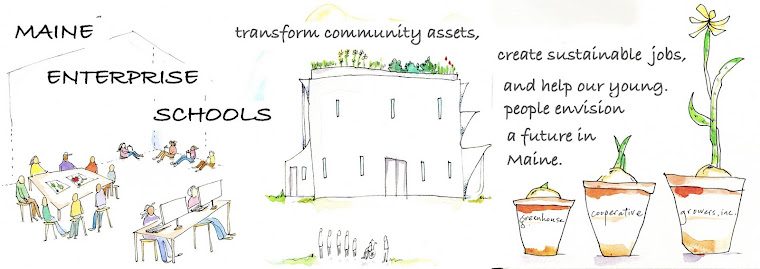
save farms, create jobs, and help our young people envision a future in Maine.

Learn about
• Our replicable public school reform model
• Our sustainable economic development model
• The specific proposals we’re working on for the Lewiston/Auburn, MidCoast, and Greater Portland areas.

Meet folks from partner organizations such as:
Maine Businesses for Social Responsibility Lots to Gardens Androscoggin Land Trust
Maine Centers for Women, Work and Community MOFGA Rosemont Market
and many more.

Wednesday, August 26th, 2009 6-9 pm at FRONTIER CAFÉ in Brunswick

Friday, July 24, 2009

Stimulus, Technology, Farm/School, EcoVillage

A quick entry to share things that came in this morning's in-box:

Obama administration school innovation money:
From a friend in Bowdoinham, a newly announced approach from the Obama administration that may impact Maine as one of the states that in some ways (no charters) is not playing along with the carrot and stick approach to school re-invention. Who wants to figure out a way to get some of that $ 5 billion to Maine?

From our friends at MOFGA, a calendar of events that includes all kinds of fascinating opportunities to learn and build community around growing things; of special interest is August 7: Connecting Classrooms to Cafeterias: From Arugula To Zucchini. Hosted by the Maine School Garden Network. This one day course will provide educators and school food service personnel with lots of great food for thought. Workshop topics will include: Integrating School Garden Activities into Classroom Curriculum; Maine Foods for Maine Kids Curriculum Program Training; The Making of a Maine Harvest Lunch Cooking Class; Classroom Composting; Integrating School Garden activities into your Curriculum; Maine Foods for Maine Kids Curriculum Program Training; Taste Testing Activities for Students; and Preserving the Harvest. The event will take place at the Gorham Middle School, 106 Weeks Rd, 9 a.m. to 4:30 p.m. $15.00 per person - includes a delicious local lunch! Download the agenda. Download the registration form.

Laptop Learning
From the NY Times: An article about another approach to a small school; some similarities to what we hope to do with Math, and an indication of the degree to which many urban systems are investing in structural innovation in a way that, Maine, despite leading the nation in student laptop programs, has not.

Belfast Ecovillage
Last: Belfast Ecovillage, an innovative attempt at rethinking the relationship between housing and farms - notable to us for it's proximity to Troy Howard Middle School, which has reinvented itself, in part, as a garden school.

Friday, July 17, 2009

Welcome to new, REAL blog

It's been three months since I wrote a blog entry; that's mostly because the old blog set-up required way too many steps, and we've been so busy that I've not sat down and discovered how easy it is to set up the...umm...easy kind of blog. So here it is. I'll try to post every weekday, and rather than just updates on progress, I'll be linking to the many fascinating people, ideas, organizations we're running into.

But first, an update on what we've accomplished:
  • Three proposals in the works, all with the potential for an MFES site in the fall of 2010: Lewiston/Auburn, Midcoast (potentially stretching from Brunswick are all the way to Belfast) and the Cumberland North Yarmouth area.
  • Our first official board meeting this coming Tuesday, at which we'll approve our Articles of Incorporation as a 501(c)3 organization (thanks to our crack legal team, Peter Lowe and Dan Stockdale).
  • A development department: Caitlin Christensen, new to Maine, comes to us by way of Texas (fundraising for service work), the University of San Francisco (community organizing on campus), and assorted gardens and Montessori schools.
  • A Chief Academic Officer-in-waiting: Erin Connor, currently Dean of Students at Andover College, former Dean of Faculty at Poland Regional High School and expert in individualizing instruction for students of every possible learning style and background.
  • So much else, but the theme of the rest is the same: the extraordinary wealth of talent and collaborative spirit of folks all over Maine - educators, farmers, parents, economic developers, entrepreneurs, social workers - all of whom see both real potential and real necessity in a new form of community that saves farms, creates jobs, and helps our young people envision a future in Maine.
Please comment, or send questions to info@mainefarmschool.org.