This story from Oregon gives lots of hope for those in small communities in Maine that may, or in some cases already have, seen their schools close.
"With dwindling enrollment and a state funding crisis, Hughes told community members the 130-student K-12 school -- split between two buildings -- would likely have to close its doors within two to three years. Now, nearly three years later, Elkton has new computers, new curriculum and materials and nearly 80 new students.
What changed? Elkton became a charter school."
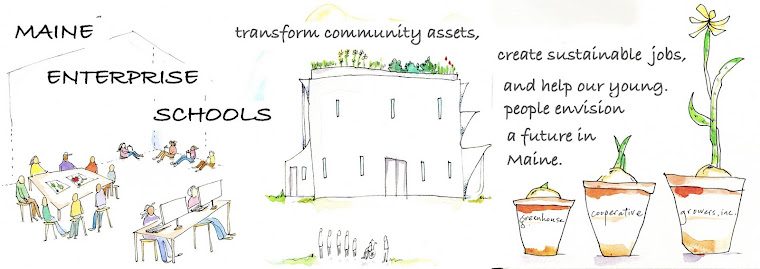
Wednesday, December 22, 2010

Monday, December 20, 2010
Charter schools suddenly 'relevant'
The charter school meeting hosted by the Maine Association of Charter Schools did indeed make clear that charters are relevant and that they are likely to happen. The 50 or so folks gathered on Thursday represented a very broad spectrum - legislators, school superintendents and potential charter school operators.
What was most exciting about the meeting is the degree to which folks who might not be seen as allies on most issues were able to find genuine common ground on the need to innovate. I spoke with a newly elected Republican legislator and a long-time liberal activist who were agreeing word for word with each other on how a well-structured charter law could help meet the needs of the young people in their very similar towns.
What continues to be discouraging is the lack of sophistication of some of the public debate surrounding charters, which came through quite loudly in the Portland Press Herald's article. My problem here is not with Mr. Stone's reporting - he has to report what is being said, and did a much better job of highlighting some of the many variables, rather than just perpetuating the myths.
What was most exciting about the meeting is the degree to which folks who might not be seen as allies on most issues were able to find genuine common ground on the need to innovate. I spoke with a newly elected Republican legislator and a long-time liberal activist who were agreeing word for word with each other on how a well-structured charter law could help meet the needs of the young people in their very similar towns.
What continues to be discouraging is the lack of sophistication of some of the public debate surrounding charters, which came through quite loudly in the Portland Press Herald's article. My problem here is not with Mr. Stone's reporting - he has to report what is being said, and did a much better job of highlighting some of the many variables, rather than just perpetuating the myths.
Saturday, November 13, 2010
MES in the news
Check out Saturday's article in the Portland Press Herald. Mr. Murphy did a superb job in capturing the potential of schools that "would be a blend of a traditional school and small-business incubator."
Group wants schools that mix business with lessons
We have a few quibbles about a few lines that could create some misunderstanding. Not the fault of Mr. Murphy, whose cheese-making example (crafted with some help from MES board member, Rosemont Market special project juggler, and very funny PPH wine writer Joe Appel) explains simply and elegantly the potential of learning linked to doing linked to the real work and markets of Mainers. The challenge Mr. Murphy, and MES faces, is describing a very different approach in the terms of the current system, which, quite frankly, makes some assumptions about learning and schools that we do not.
Group wants schools that mix business with lessons
We have a few quibbles about a few lines that could create some misunderstanding. Not the fault of Mr. Murphy, whose cheese-making example (crafted with some help from MES board member, Rosemont Market special project juggler, and very funny PPH wine writer Joe Appel) explains simply and elegantly the potential of learning linked to doing linked to the real work and markets of Mainers. The challenge Mr. Murphy, and MES faces, is describing a very different approach in the terms of the current system, which, quite frankly, makes some assumptions about learning and schools that we do not.
Friday, November 12, 2010
Time to Address Child Poverty and High Dropout Rates in Maine
From Brunswick Times-Record:
Time to Address Child Poverty and High Dropout Rates in Maine
I have often wondered why, as a society, we find it so difficult to address crucial problems like child poverty, child neglect, high dropout rates and student underachievement. Instead, we grind and rattle our way down the road until the wheels fall off the cart. We are now at the breakdown point with regard to our at-risk kids, and the costs of doing business as usual are bankrupting us. Consider the following:
• On average 21 students in Maine drop out of school each day, with the class of 2009 estimated to have lost 3,800 kids.
• The societal cost for each high-school dropout is approximately $292,000, due to reduced wages and taxes, welfare and high health-care costs, and--as is all to often the case--the costs of incarceration.
• Dropouts are 3 1/2 times more likely to wind up in jail than non-dropouts.
• It costs approximately $47,000 per year to incarcerate someone—more than the cost of sending that person to Harvard ($43,000).
Time to Address Child Poverty and High Dropout Rates in Maine
I have often wondered why, as a society, we find it so difficult to address crucial problems like child poverty, child neglect, high dropout rates and student underachievement. Instead, we grind and rattle our way down the road until the wheels fall off the cart. We are now at the breakdown point with regard to our at-risk kids, and the costs of doing business as usual are bankrupting us. Consider the following:
• On average 21 students in Maine drop out of school each day, with the class of 2009 estimated to have lost 3,800 kids.
• The societal cost for each high-school dropout is approximately $292,000, due to reduced wages and taxes, welfare and high health-care costs, and--as is all to often the case--the costs of incarceration.
• Dropouts are 3 1/2 times more likely to wind up in jail than non-dropouts.
• It costs approximately $47,000 per year to incarcerate someone—more than the cost of sending that person to Harvard ($43,000).
Saturday, October 23, 2010
Rationale for Maine Enterprise Schools explained!
If you can find 11 minutes in the next day or two, I urge you to find time to listen to/watch Ken Robinson's animated dissection of the degree to which our current system of education is profoundly unsuited for our times and our children.
http://www.youtube.com/user/theRSAorg
Many of you have heard me or others say many of the same things - that batch processing kids deadens their motivation, that natural curiosity gets labeled ADHD, and that we make a false and damaging distinction between academic learning and hands-on learning. My favorite part, if were not so sad, would be when he shares the study that demonstrates the degree to which, over time, our schools greatly reduce the natural capacity for divergent thinking that almost every child is a "genius" at.
I'll be showing this video everywhere I can from here on out - Sir Kenneth elucidates the intellectual underpinnings of what we're trying to do with Maine Enterprise Schools better than I ever could - and it makes me that much more eager to be part of the creation of a new system, were the beauty of an education driven by deep, lived experience with the arts, ecosystems, and the real work of humans (and their machines) is available to every single child, regardless of place or parentage.
http://www.youtube.com/user/theRSAorg
Many of you have heard me or others say many of the same things - that batch processing kids deadens their motivation, that natural curiosity gets labeled ADHD, and that we make a false and damaging distinction between academic learning and hands-on learning. My favorite part, if were not so sad, would be when he shares the study that demonstrates the degree to which, over time, our schools greatly reduce the natural capacity for divergent thinking that almost every child is a "genius" at.
I'll be showing this video everywhere I can from here on out - Sir Kenneth elucidates the intellectual underpinnings of what we're trying to do with Maine Enterprise Schools better than I ever could - and it makes me that much more eager to be part of the creation of a new system, were the beauty of an education driven by deep, lived experience with the arts, ecosystems, and the real work of humans (and their machines) is available to every single child, regardless of place or parentage.
Tuesday, October 12, 2010
Impact Investing
NY Times article, fowarded by Russel Libby of MOFGA, points out that while "the notion that for-profit companies with a social mission at their core could constitute an “asset class” is fairly new," the sector is poised for "explosive growth."
Plenty of challenges, not the least of which is "the mindset of many investors." But the article illustrates that the kinds of social investing/venture philanthropy strategies that MES is creating are out there, are growing, and will have an impact.
Plenty of challenges, not the least of which is "the mindset of many investors." But the article illustrates that the kinds of social investing/venture philanthropy strategies that MES is creating are out there, are growing, and will have an impact.
Sunday, October 3, 2010
Name Change, Partnership, Temporary Website
Maine Enterprise Schools has dropped the Farm from our name and we're entering into partnership with Learning Works to jointly develop the MES concept. We're working on a new website, but until we get there, this blog will serve (along with our facebook site) to update folks. The links above lead to various aspects of our work to date. To the right is our Innovation Maine education blog (to which we're posting regularly now) and the MaineFarmSchool.org site, along with an assortment of links that inform our work.
Let us know what you think...comment or email John at jdanieri@mainefarmschool.org
Let us know what you think...comment or email John at jdanieri@mainefarmschool.org
Subscribe to:
Posts (Atom)